Dump Trailer Body Parts: An RFQ Checklist for Buyers

Start with the assembly, not a photograph
A photograph helps identify the type of trailer you are building. It does not define the parts you want to buy. A reinforced sidewall may look similar to another sidewall while having different corner geometry, rail height, material, floor connections and tailgate clearances. A quotation based only on appearance leaves those decisions open.
For agricultural or construction dump trailer body parts, begin with one assembly view showing the front, rear, left and right orientation. Add individual part drawings and a bill of materials. If the design is still being developed, identify the drawings that are preliminary. Ask the fabricator to list assumptions and exclusions rather than treating an early budget price as a production-ready offer.
This guide concerns fabricated body components for customer assembly. Complete trailers, running gear, hydraulic systems and vehicle approval are separate scopes unless expressly included and accepted in an order.
The body-parts RFQ at a glance
| Information | What to provide | Why it matters |
|---|---|---|
| Assembly layout | Orientation, overall envelope and item references | Connects individual parts to the intended build |
| Bill of materials | Part number, revision, quantity per set and order quantity | Defines exactly what is included |
| Material | Grade, standard, thickness and documentation needs | Prevents an appearance-based substitution |
| Interfaces | Datums, holes, flanges, hinge axes and critical clearances | Defines fit at the customer’s assembly stage |
| Supply condition | Loose, formed, welded, machined or finished | Separates supplier work from customer work |
| Release requirements | Inspection records, marking, packing and destination | Makes offers easier to compare |
1. Divide the package into recognizable component groups
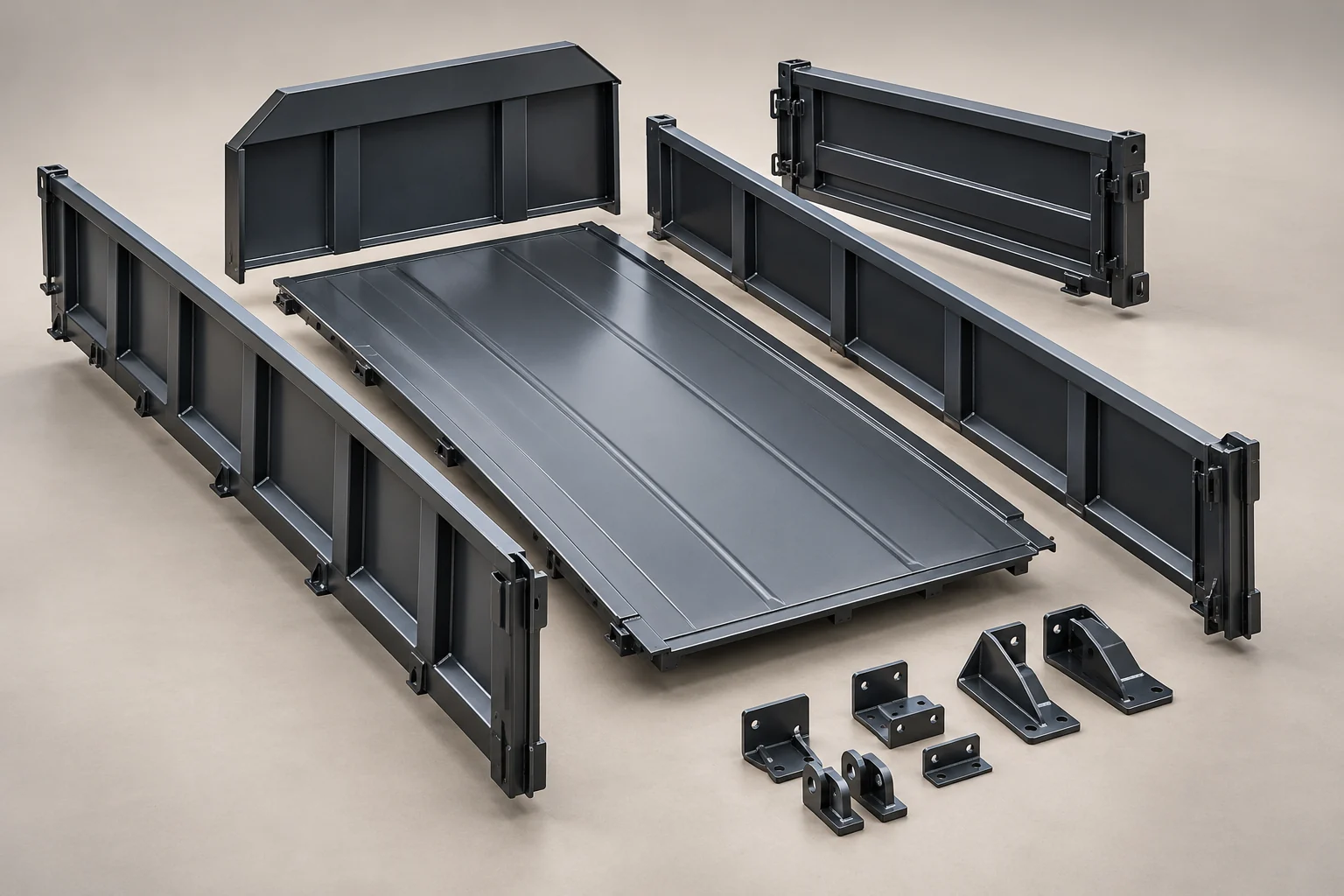
Organize the request around the way the body will be assembled. Common groups are left and right side panels, a front bulkhead, a rear tailgate, a floor fabrication and brackets and supports. Include loading ramp components only if they are part of your design and procurement scope.
Give each group an item reference. A purchasing description such as “one body set” is useful only when the drawing package defines that set. A simple quantity relationship prevents mistakes: show the quantity of each part per assembly and the number of assemblies ordered. Where left and right parts differ, assign separate part numbers even if the parts appear almost symmetrical.
Also identify purchased hardware. Pins, bushes, latches, seals, fasteners and actuators should not disappear inside the word “tailgate.” List whether the supplier provides them, fabricates only the mounting interfaces, or leaves them entirely to your team.
2. Specify the condition in which each part should arrive
A floor plate supplied loose is a different scope from a floor supplied with welded underside reinforcement. The same is true of a flat side panel, a formed side section and a reinforced welded sidewall. Use the drawing and quotation to identify the handover point.
- Loose parts: define whether cutting, deburring and any hole finishing are included.
- Formed parts: show the finished geometry, bend references and mating faces.
- Welded subassemblies: identify joints, reference datums and the dimensions that apply after welding.
- Finished components: state the coating specification and any masked interfaces.
This is also the time to state whether temporary transport supports, identification labels or matched grouping are required. They should be agreed deliverables, not assumptions made after fabrication.
3. Make assembly interfaces visible
Overall length and width do not describe every fit requirement. For a sidewall, the important features may be the bottom flange, corner relationship and rear opening. For a tailgate, the important features may be the hinge axis and latch positions. For a bracket, a hole pattern may need to relate to a machined face rather than an untrimmed plate edge.
Mark the functional datums and distinguish critical dimensions from general dimensions. State whether the acceptance requirement applies before or after welding and finishing. This helps the fabricator choose inspection references that match the way your assembly team will use the part.
Where a sample fit check or an assembly trial is required, define its scope: which mating parts are included, who supplies them, what will be measured and what constitutes acceptance. A photograph of parts placed next to each other is not the same deliverable as a documented fit check.
Welding-related thermal expansion and contraction can change geometry, as explained by TWI’s overview of distortion causes. Define the condition in which your critical dimensions are to be accepted.
4. Compare inspection and documentation scope
Ask every bidder to respond to the same document requirements. Depending on the project, these can include material documentation, a dimensional inspection record, welding inspection records and finishing documents. Confirm what will be supplied for the actual order rather than assuming that a general quality statement covers every component.
A useful inspection request names the feature, reference and acceptance requirement. “Check the floor” is broad; “record the agreed floor envelope and attachment locations against the assembly datums” is easier to interpret. See our quality and inspection page for the types of requirements to define.
There is no single inspection package that suits every trailer part. The right scope depends on the drawing, component function and customer requirements. Any load testing or system validation must be separately defined and accepted.
5. Include packing and receiving requirements
Long panels and finished interfaces can be difficult to identify after packing unless part references remain visible. Ask for a packing list that matches the bill of materials. Specify left/right marking, protection of machined or coated surfaces, and any need to group components by assembly.
Provide the delivery destination and handling constraints early. A package arranged for one receiving method may be unsuitable for another. Packing dimensions, quantities, transport protection and unloading requirements need commercial agreement; do not assume a rendering demonstrates the final shipping arrangement.
A practical example of a clearer request
Ambiguous: “Please quote steel parts for a dump trailer like the picture.”
Clearer: “Please quote the components listed in the attached bill of materials, using the stated drawing revisions. Supply the floor and sidewall fabrications in the assembly condition identified for each item. Quote finish, inspection documentation and packing as separate confirmed scope items. Identify exclusions and any features needing clarification.”
This is an illustrative purchasing example, not a customer case study. The improvement comes from defining the scope, not from adding a promised delivery time or an arbitrary tolerance.
Frequently Asked Questions
Can I request only the body panels rather than a complete trailer?
Yes. Specify the individual panels or fabrications in the bill of materials and identify the components your own team will supply or assemble. The agreed quotation determines the scope.
Is a photograph enough for a production quotation?
A photograph can identify the application, but production pricing needs drawings or equivalent dimensional and material requirements. Any assumptions in a preliminary quote should be recorded.
What is the difference between a component package and a kit?
A component package is an agreed group of supplied parts. Calling it a standardized kit would additionally imply a defined configuration and included items. Confirm the bill of materials and assembly requirements rather than relying on the label.
Do the images establish dimensions or load capacity?
No. Application and component illustrations identify the type of parts being discussed. Dimensions, interfaces, material and any design or validation requirements must come from the approved project documents.
Related Reading & Components
Sources & Further Reading
These references support the specific technical context discussed above; they do not certify our components or replace project-specific design review.