Dump Trailer Floor Panels: What to Specify Beyond Thickness
Why thickness is only the starting point
Buyers often begin a dump trailer floor inquiry with a single question: “What thickness should the bottom plate be?” It is a useful starting point, but it is not a complete manufacturing specification. The same plate thickness can appear in floors with different spans, supporting members, attachment details and service conditions.
For a drawing-based component order, the fabricator needs to know what is being manufactured and which requirements must be verified. The design team determines the structural arrangement and any required validation. The procurement team’s job is to transmit that design clearly so different quotations describe the same floor.
This article explains the specification fields to review when sourcing dump trailer floor panels and floor assemblies. It does not prescribe a universal thickness, steel grade or working load.
Compare the specification fields together
| Specification field | Question to resolve | RFQ document |
|---|---|---|
| Plate | Which grade, standard and thickness apply? | Material note and part drawing |
| Reinforcement | Which profiles, spacing and end details are required? | Underside layout and sections |
| Connections | How does the floor meet sidewalls and other structures? | Assembly interfaces and datums |
| Welding | Which joints and acceptance requirements apply? | Weld details and inspection scope |
| Dimensions | Which values apply after fabrication and finish? | Finished-state inspection drawing |
| Delivery | What surface condition, marking and packing are needed? | Finish and packing requirements |
1. Name the material without assuming equivalence
Write the specified grade and applicable material standard on the drawing or purchase specification. “Steel floor” leaves a major requirement undefined. If a different material is proposed, request the actual grade and supporting documentation for design review rather than accepting a substitution based only on thickness or appearance.
When wear plate is part of the design, its processing requirements also deserve attention. For example, SSAB publishes product-specific guidance for welding its Hardox wear plate, including joint preparation, consumables, preheating and heat input. That guidance is explicitly limited to the manufacturer’s relevant products; it should not be copied as a universal procedure for other steels. Read SSAB’s stated scope and considerations.
A named material in a buyer’s drawing is not a claim that a supplier routinely stocks that material. Confirm procurement, processing and documentation availability for the order.
2. Treat underside reinforcement as part of the floor
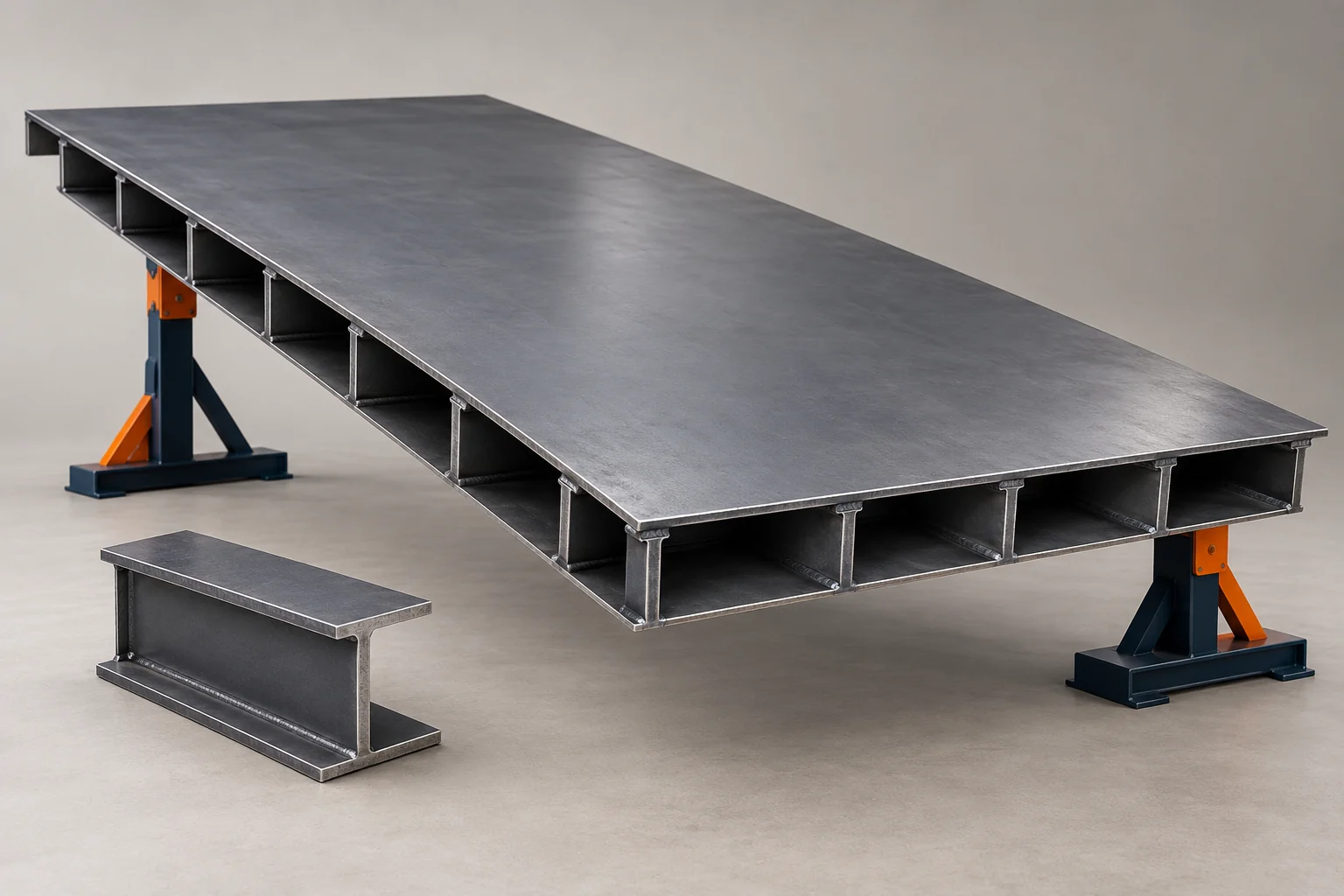
A plate-only quotation and a reinforced-floor quotation are not directly comparable. Show the underside arrangement, profile sections, orientation and member end details. Include the positions at which reinforcement connects to rails or other interfaces defined in your assembly.
Identify whether the supplier fabricates the complete floor assembly or supplies the plate and reinforcing components separately. That distinction changes the manufacturing sequence, inspection references, packing arrangement and work remaining for the customer.
If a visual rendering accompanies the RFQ, use it to explain orientation only. The controlled drawings should define the profiles and spacing. An illustration cannot determine whether a member is a channel, a closed section or a folded plate fabrication.
3. Define the sidewall and attachment interfaces
The floor’s outer envelope is not the only relationship that matters. Sidewall angle, bottom flanges, front corners and the rear opening can affect how the body fits together. State which surfaces or features establish the common reference system.
For a coordinated package, send the body assembly and bill of materials alongside the floor drawing. Identify any parts that will be welded or bolted to the floor later. If hole positions relate to the finished assembly, make that relationship explicit instead of leaving the supplier to measure from a convenient cut edge.
Also distinguish permanent attachment features from temporary handling provisions. Lifting points or transport supports require an agreed scope; they should not be inferred from a product picture.
4. Agree the welded condition and dimensional checks
Welding introduces a thermal cycle that can change geometry. TWI describes transverse and longitudinal shrinkage, angular distortion, bowing and other forms of distortion associated with welded fabrication. This supports a practical purchasing question: which dimensions must be checked after the floor has been welded? See TWI’s overview of distortion types.
Specify the finished-state envelope, the datums used for measurement and any agreed flatness or interface requirements. Do not use “perfectly flat” as a substitute for a measurable acceptance requirement. Where support conditions influence measurement, identify the inspection setup with the supplier.
The manufacturing route may include fixturing and a defined weld sequence. Those measures need to fit the actual joint design and material; adding clamps is not a universal solution. Ask how the agreed critical features will be inspected rather than prescribing a process without reviewing the fabrication.
5. Describe the surface condition and finishing scope
State whether the floor is delivered as fabricated, prepared for a customer-applied finish, or supplied with an agreed coating. Identify the top surface, underside, edges and mating areas separately where their requirements differ.
For coated parts, define the coating system, preparation, protected areas and documentation that matter to your build. A color description alone does not define the full finishing scope. If your team will weld the floor into a larger assembly, discuss the required delivery condition before the finish is selected.
THYH Trailer Parts coordinates painting, powder coating, galvanizing and other agreed surface treatments through external suppliers. These are not represented as in-house coating operations. Availability and the applicable specification are confirmed with the order.
A receiving checklist for floor fabrications
- Match the part number and drawing revision to the purchase order.
- Confirm the material documentation required by the order.
- Compare the reinforcement arrangement with the approved underside layout.
- Review the recorded critical dimensions and any agreed weld inspection documents.
- Check the specified surface condition and protection of mating interfaces.
- Identify transport damage and discrepancies before the component enters assembly.
This is an illustrative receiving checklist, not a replacement for the project’s inspection or engineering requirements. Agree additional checks where the design or intended duty requires them.
Frequently Asked Questions
Is a thicker dump trailer floor always the better choice?
Thickness alone is not a complete selection rule. Material, support arrangement, connections, intended duty and the complete design must be considered together by the responsible design team.
Should I quote the bottom plate and reinforcing members separately?
You can request either loose components or a welded floor fabrication. Identify the supply condition for every item so quotations and the remaining customer assembly work are comparable.
Can a wear-resistant grade be substituted for ordinary steel?
Do not assume equivalence. The proposed material and its processing requirements need review against the design. Record any accepted substitution in the controlled drawing and order documents.
Which dimensions should be inspected?
Identify the dimensions and interfaces that matter to the assembly, their datums and the condition in which they apply. Agree the actual dimensional and weld inspection scope before production.
Related Reading & Components
Sources & Further Reading
These references support the specific technical context discussed above; they do not certify our components or replace project-specific design review.